Photobucket Photobucket Photobucket Photobucket Photobucket Photobucket


Showing posts with label music. Show all posts

Friday, May 23, 2008

Our 3rd Grade Composer Studies


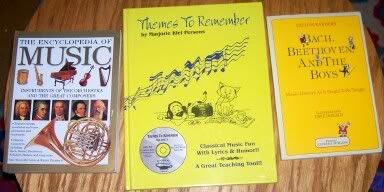
We are studying 4 composers this year, Vivaldi, Bach, Handel and Haydn, one for each quarter. Maybe I should say that the kids will have lunch with different composer each quarter because that is how I'm going to accomplish this. At lunch each day of our first quarter we will listen to Vivaldi and I will read aloud his biography while the kids eat. We have various resources for composers already, ones that aren't shown above like:

- Meet the Great Composers (Book 1 and 2 with CDs)
- Vox Music Masters CDs which have a narrative with the compositions
- Classical Music CDs that I've bought on sale for each composer
- Bach, Beethoven and the Boys by David Barber
- Madeleine Goss biographies (out of print but wonderful): Deep-Flowing Brook, The Story of Johann Sebastian Bach
- Two encyclopedias of music
- Composer coloring books


But I wanted this time to be simple, just a listen while you eat experience. There will be no coloring pages or worksheets, this is purely a "just enjoy" focused lesson. Sometimes making studies more academic takes the joy out of it and we have plenty of time down the road to make composer studies more formal.

Here's the spine of our time: listen to the compositions with or without a biography reading and at the end of the quarter we will watch a DVD if there is an age-appropriate one available. Classical Kids and the Composer's Specials provided many age-appropriate DVD titles to enjoy. I will be switching out what we listen to, from listening to Themes to Remember which provide lyrics to help a child learn to just listening to the compositions themselves. Reading the biography will not compete with what we're listening to so CDs that have spoken words will be done on days of their own without reading the biographies. The Opal Wheeler biographies are short and very age-appropriate, the Madeleine Goss biographies are intended for an older audience, I'd say 5th grade and above but can be read aloud by a discerning parent.

Of course this means I will not be eating with the kids but I put Independent Reading right after lunch so I can eat while they are reading. I say this but I also know that Danny cannot read yet but he does enjoy having his own basket of books to explore which will be a daily habit I hope to instill in him- to have his own quiet time with books daily. I have struggled with how to fit all that I desire for my children into our day and through learning from other homeschoolers, I've realized it's just a matter of how I actually spend the time we have. I'll also be playing the composer of the quarter in other situations like in the car or when we're doing chores and any other time throughout the day I can slip it in.

The resources I've listed are things we have on hand, it's not necessary to spend a lot of money to start an informal study. The essentials are CDs and the rest can be from the library. Also, realize I'm writing all this before putting this plan into action with all my idealistic hopes and desires. Smile.


Thursday, March 20, 2008

Ideas for 3rd Grade

again from my notes...

The year will be split up into 4 quarters, as there are 4 units in each year of TOG. Each quarter will be about 9 weeks with 1 week off. A proposed schedule

Sept 15th - Nov 10th = First Quarter
.............Nov 17-28th off, two weeks
Dec 1-19th, Second Quarter continues..
.............Dec 22-26th off
Dec 29- Feb 6th = Second Quarter
.............Feb 9-13 off
Feb 16- April 17th = Third Quarter
.............April 20-24 off
April 27-June 26 = Fourth Quarter

This will allow us to start AFTER the projected release dates of TOG Redesign Year 3 and Year 4 for 4th grade.

Each Quarter:

Read about and listen to- one composer in the Baroque Period 1600-1750.
1st- Antonio Vivaldi
2nd- Johann Sebastian Bach
3rd- George Frideric Handel
4th - Franz Joseph Haydn (Classical Period 1750-1820)

Focusing on one composer at a time will allow us to rent DVDs, get familiar with their pieces and learn more deeply about each composer. We will read biographies by Opal Wheeler and Madeleine Goss as well as any picture books the library can provide. We will also learn the themes from Themes to Remember 1 by Classical Magic. Camille will work on creating a presentation on each composer.

Scientist Biographies - at least two each quarter
These will be in the framework of our history studies. I have not seen the book list for TOG Year 3 so this will be decided upon later. There will be an extension project, for at least one scientist, utilizing art and writing if not experiments. I think 1 per 3 weeks is more than enough to read and accomplish a project. *I may simplify this to just reading aloud and narrating if it is too much. This will be a Masterly Inactivity exercise.

Art will be through projects and formally using Drawing With Children by Mona Brooks.
She wants art, she'll have art- coming out of her ears! Lol. Nature Journal, Art Lessons, History and Science projects.

I may add more to this later


Wednesday, December 12, 2007

Her First Piano Recital


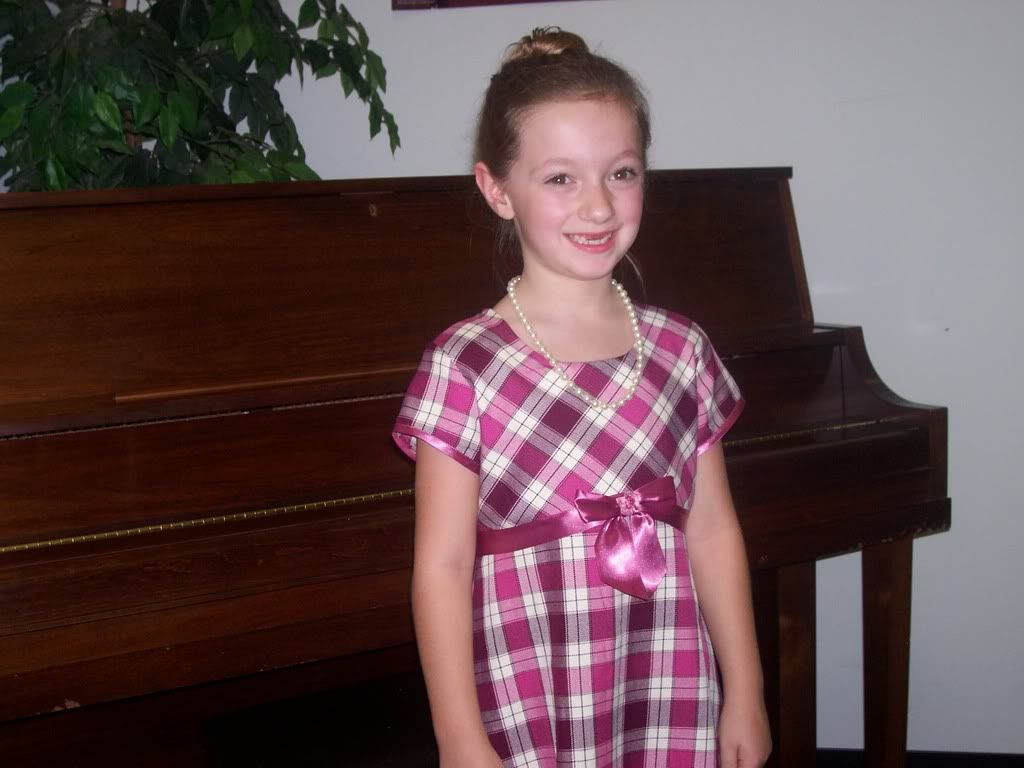
She was the first one to perform, in her first recital. We're all very proud of her!


Sunday, September 9, 2007

Skip Counting Resources

I've been shopping for a skip count cd to help aid our learning in a more fun way. I figured I would share the resources I came across because there is a small selection out there and even I had a hard time deciding! Especially since the samples online at times only give you 40 seconds of the song.

There is a difference in addition, multiplication cds and skip counting. Skip counting is a sequence of numbers: 2, 4, 6, 8, 10, 12, 14, 16, 18, 20...and multiplication songs are usually the facts: 1x1, 1x2, 1x3, etc. There is one exception that I found.

Sara Jordan's Multiplication CD has the multiplication facts and within each number's song, there is a chorus of skip counting for that number. http://www.sara-jordan.com/product-111.shtml

Strictly skip counting cds options:

Intelli-Tunes Skip Counting CD. This is the one we decided to purchase because it wasn't distracting with a bunch of lyrics and got down to the nitty-gritty of the number sequences, much like I've been doing on my own.
http://www.songsforteaching.com/store/Intelli-Tunes-Skip-Counting-CD-p-1182.html

Skip Count Kids has two versions, one that would be considered secular and one that has Bible songs. We own the The Skip Count Kids Bible Heroes and like it but the number sequences only go so far in some of the songs. This has been great for us and I like the Bible Hero lyrics. Camille still sings these songs for fun.
Skip Count Kids at SingnLearn.com, link to Bible Heroes version too.

One Hundred Sheep is another skip count CD available at Singnlearn.com, I was unable to determine how complete the sequences were but the sample sounded good. This has been recommended by other homeschoolers yet without more information I could not commit to purchasing it. One Hundred Sheep at Singnlearn.com

Googol Power Skip Counting Zone CD is a lot of fun with all different types of music. The samples are great, providing a sample for each song, which I was grateful for! Unfortunately, Camille prefers not to have so many lyrics, although this isn't lyric heavy in my opinion. It is definitely a CD that I would consider "fun" listening but I didn't have the need to purchase more than one CD at this time. Googol Powers's Skip Counting Cd link

Musical Mathematics with Skip Counting CD by Liz Robinson is a filled with different types of music and provides the instrumental versions of the songs so that you can see if your child can skip count without the lyrics. There are worksheets and teacher's aids available as well. I thought this was great but we're picky (or Camille is) and didn't prefer the music. Link to Musical Mathematics

Math-U-See Skip Count Songs is for Math-U-See users although some have bought this without using Math-U-See. I didn't explore this further than other homeschooler's reviews of it, it seems that no one has really enjoyed this and tend to look for other options, the sample doesn't help in my opinion either. Link to Math-U-See Skip Count Songs

Skip Counting CD by Little Giant Steps. I couldn't find much information on this other than it says there is no music. I didn't consider this further due to lack of information on the product (hint, hint to the vendors and suppliers!).
Link to Skip Counting by Little Giant Steps

Obie Leff's Skip Counting Fun, this is great for the number sequences but Camille said the music is boring. His songs are available at iTunes Music Store so you can preview each song yourself, CD Baby has the song samples as well. This was a contender until we found Googol Power and Intelli-Tunes. Link to CD Baby's listing of Skip Counting Fun

TouchMath's Skip Counting CD and Poster set. This looks great but I can't afford the $75 for it. I think it's a great idea but a resourceful teacher could easily recreate the posters if he/she wanted to. I couldn't find samples of the songs either. Touch Math link

That concludes our search for skip counting CD's, the search gets a little mucky after these selections- some CDs have skip counting songs on them mixed in with other math related songs. If you know of another that you feel should be added to this resources list, let me know. The comments made above are only Camille's (7yo) and I opinion of what we sampled, one of these resources that we didn't like may be the perfect thing for your family.


Sunday, September 2, 2007

Week 7: The Books

We haven't done music the way I've wanted to, we've listened to Vivaldi's "Spring" of the Four Seasons for three weeks now. It is time to read about him and move on. Bach, Beethoven and the Boys will be delightful reading (with a little edit).

We're on Chapter 6 of SOTW 2: The Rise of Islam.
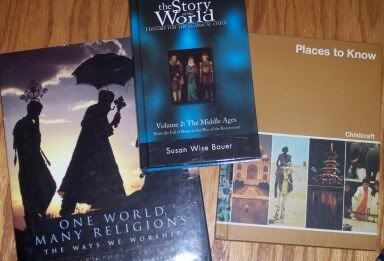
We'll read about Islam in One World, Many Religions and look at pictures of a Mecca in Places to Know.
Take a virtual tour of the Suleymaniye Mosque with 360 degree views and narration.

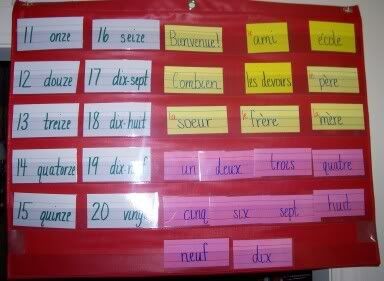
Our French word wall, last week we "reviewed" (we already knew them) numbers 1-10.
In Friday's French culture we'll learn about french schools and read Sleeping Beauty in the Wood.
Last week we read Puss in Boots from Favorite Fairy Tales from Around the World.

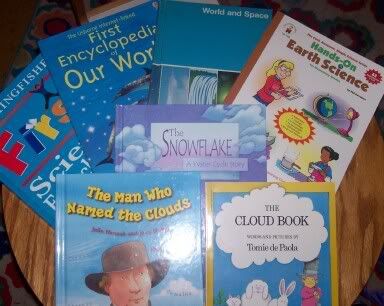
I am loving science this year! For September in the weather journal Camille will be documenting what type of clouds are in the sky and it lined up perfectly for our study of the weather in our Earth Science studies. I forgot to include "The Geography Book" by Caroline Arnold which is our geography portion of our earth science studies. BUT, we will be reading about the Water Cycle and making (maybe?) a rain gauge from The Geography Book. The books pictured are prime examples of EXCELLENT children's books for science. The Man Who Named the Clouds is wonderful and thorough, The Snowflake is about the water cycle and The Cloud Book, if you couldn't guess - is about the clouds.

Not pictured:
Because of Winn-Dixie, Camille's independent reading selection
Storytime with the Millers, daily read aloud
A few books from the library about Islam that may or may not be available in time.
The 15 books I will be reading to Danny this week.


Thursday, August 16, 2007

Themes to Remember Review


ClassicalMagic.net has a music program that we love which can be used for children aged 2 and up. I'm even enjoying it! First off, I appreciate the books are hardcover, which lends an everlasting quality to them and it is apparent that Marjorie Kiel Persons spent a lot of time developing this product. Marjorie holds majors in Elementary, Secondary, Music and Religion Eduction as well as English literature and has traveled extensively.

You can read the hows and whys of how the program was developed, here and even literary benefits of the program. In each book, Persons provides a "how to" guide and practical teaching suggestions which is very helpful which includes: Listen and Sing Along, Meet the Composers, Musical terms, Games (three provided), Art, Drama, and Movement. This program is for multiple learning types and the approach is up to the parent/teacher. Your child will learn about the orchestra, opera, history of the composers, their individual styles and influences, musical terms and really come to understand the music.

In Themes to Remember Volume 1 and 2 there are illustrations for younger children, a biography of the composer with a portrait of composer (which can be purchased as an additional set separately), music terms about the particular composition or composer and lyrics to help memorize the composition. On each cd that accompanies each book there is the composition and a track that plays the composition with the lyrics. It is pleasant and fun. It sounds simple but you'd be amazed at how much your child will learn effortlessly with this program by just reading the biography, learning the music terms and singing the lyrics (memorization would be best) which is just the beginning!

Each book shares about each major time in classical music and the program could be used to study music chronologically or incrementally as the 6 year schedule that Classical Magic recommends. We're using the six year schedule, which is also why I bought the three books, there is a fourth book, Antonin Dvorák From the New World with Lyrics which tells the story of Dvorák's life in both prose and lyrics, and includes reproducibles plus a listening guide for the orchestrated recording on the CD.. The CD contains, in addition to tracks of the themes with and without lyrics, a fully orchestrated recording of the Symphony (without lyrics).

The purpose of the six year schedule is to introduce children to the simpler concepts first and then gradually increase the difficulty to match their knowledge. Even though Camille is in 2nd grade, we're starting in Year 1 which could also be used with kindergarten and younger aged children. Can I just say that it is nice to know that we have a study of classical music selected for six years! It is a relief for me and I hope no qualms about what she'll be learning. If you have multiples and are just starting out, I would keep them together and start from the beginning of the six year schedule, if that's the route you select.

With help from another homeschool mom, I created a schedule for Year 1 that we're using this year. We are studying one composition and composer for two weeks and I supplemented the schedule with living books, encyclopedia information and coloring books. Here's our Year 1 approach. If you'd like to see the whole six year schedule, click here to go to Classical Magic. For five of the six years, you'll only need the three books Themes to Remember 1, Themes to Remember 2 and Classical Karaoke for Kids, there is only one year that requires the Dvorák book which is why I purchased the three books at one time.

If you wish to know more about the lyrics included, here at places you can view them: Handel and Boccherini, more inside pages to be viewed at RainbowResource.com for Themes to Remember Vol. 1, and Themes to Remember Vol 2., and at SingNLearn.org.


Friday, February 23, 2007

Classical Music Study Plan Updated!

The classical music study plan has been updated and revised. Check it out here, http://triviumacademy.blogspot.com/2007/01/classical-music-study-plan.html

It utilizes Themes to Remember, from ClassicalMagic.net as its spine and the six year schedule.
I hope sharing this will help others and it would be a blessing for others to decide to add music to their homeschools!


Wednesday, January 31, 2007

Classical Music Study Plan

I purchased Themes to Remember: Volume 1, Themes to Remember: Volume 2 and Classical Karaoke for Kids by Marjorie Kiel Persons, detailed at ClassicalMagic.net because I want to use their Six Year schedule. There are teacher's manuals for the books but I've been told that they are for classroom use which I don't need. This doesn't break my heart becaue the teacher's manuals are $23.95 each and that's pretty expensive when you may want to purchase enrichments on top of that.

Through the wonderful world of online book trading via Book Mooch, I have acquired Bach, Beethoven and the Boys by David Barber, The Encyclopedia of Music (which you could use any encyclopedia of music), and other various books for the K-3 reading level.

Stories of the Great Composers Book 1 by June Montgomery and Great Composers Book 2 by Hinson (these provides activities and additional readings).
Vox Music Masters cds which have narratives of the composers biography along with compositions they've written
Then library books as they are needed or desired.

You do not need to have the same items I have, you can make this schedule your own - use any encyclopedia, use any enrichments you have handy.


KINDERGARTEN SCHEDULE
Our chosen starting place with the six year schedule

THEMES TO REMEMBER 1

Vivaldi - Spring from The Four Seasons
Week 1: Read pg 6, vocabulary, learn song on pg. 7
Week 2: Review song, Read about Vivaldi in BBTB, Encyclopedia of Music, Vox

Bach - Toccata & Fugue in Dm (Theme 1)
Week 1: Read pg. 8, vocabulary p.10, GC1 Unit 1, Learn song
Week 2: Review, Read pg. 45 BBTB, Encyclopedia, Bach (home library), Vox

Haydn - Surprise Symphony
Week 1: pg. 24, vocabulary, learn song p.25, GC1 Unit 2
Week 2: Review song, BBTB pg. 65, Encyclopedia, Vox

Boccherini - Minuet
Week 1: Read pg. 26, vocabulary, song pg. 27
Week 2: Review, Encyclopedia

Mozart - Symphony No. 40
Week 1: Read pg. 28, song pg. 29
Week 2: Review, BBTB p70, Encyclopedia, Mozart (home library), Vox

Beethoven - Symphony No. 5, Mvt. 1
Week 1: Read pg. 30, vocabulary, song pg. 31, GC1 Unit 3
Week 2: Review, BBTB p79, Encyclopedia, Beethoven (home library)

Beethoven - Symphony No. 9
Week 1: Read pg. 30, review vocabulary, song p 32, Beethoven Lives Upstairs
Week 2: Review, Beethoven Lives Upstairs, Vox

Schubert - Unfinished Symphony
Week 1: Read pg. 34, vocabulary, song p. 35, GC1 Unit 4
Week 2: Review, BBTB p. 97, Encyclopedia

Schubert - Trout Quintet
Week 1: Read pg. 34, review vocabulary, song p. 36, GC2 Unit 3
Week 2: Review, library book, Vox

Schumann - The Happy Farmer
Week 1: Read p. 36, vocabulary, song p. 47, GC2 Unit 6
Week 2: Review, BBTB p. 101, Encyclopedia, Vox

Brahms - Lullaby
Week 1: Read pg. 52, vocabulary, song pg. 53
Week 2: Review, BBTB p. 90, Encyclopedia, Vox, Venezia

Souza - Stars and Stripes Forever
Week 1: Read pg. 85, vocabulary, song p. 86
Week 2: Review, Encyclopedia, Vox, Venezia


THEMES TO REMEMBER 2


Tchaikovsky - The Nutcracker - Story and Music
Week 1: Read pg. 76-87, vocabulary, play full length song, GC2 Unit 8 Week 2: Review, play song again, BBTB p. 114

Tchaikovsky - The Nutcracker - Overture
Week 1: Read pg. 74, vocabulary, song pg. 75
Week 2: Review, Encyclopedia, Venezia

Tchaikovsky - The Nutcracker - March of the Toy Soldiers
Week 1: Tchaikovsky (home library), vocabulary, song pg. 79
Week 2: Review, Vox, rent The Nutcracker


BOOKS TO USE AS ADDITIONAL READING:

In Lives of the Musicians by Kathleen Krull: Vivaldi* . Bach* . Mozart* . Beethoven* . Chopin . Verdi . Schumann* . Foster . Brahms* . Tchaikovsky* . Gilbert & Sullivan . Satie . Joplin . Ives . Stravinsky . Boulanger . Prokofiev . Gershwin . Guthrie


Getting to Know the World's Greatest Composers Series; by Mike Venezia

* George Gershwin, Children's Press (Chicago, IL), 1994.
* Peter Tchaikovsky, Children's Press (Chicago, IL), 1994. *
* George Handel, Children's Press (Chicago, IL), 1995.
* Aaron Copland, Children's Press (Chicago, IL), 1995.
* Wolfgang Amadeus Mozart, Children's Press (Chicago, IL), 1995. *
* Duke Ellington, Children's Press (Chicago, IL), 1995.
* Igor Stravinsky, Children's Press (Chicago, IL), 1996.
* Ludwig Van Beethoven, Children's Press (New York, NY), 1996. *
* The Beatles, Children's Press (New York, NY), 1997.
* Leonard Bernstein, Children's Press (New York, NY), 1997.
* Johann Sebastian Bach, Children's Press (New York, NY), 1998. *
* John Philip Sousa, Children's Press (New York, NY), 1998. *
* Frédéric Chopin, Children's Press (New York, NY), 1999.
* Johannes Brahms, Children's Press (New York, NY), 1999. *

Opal Wheeler composer biographical fiction:

Adventures of Richard Wagner by Wheeler
Curtain Calls for Franz Schubert by Wheeler and Deucher *
Curtain Calls for Joseph Haydn and Sebastian Bach by Wheeler and Deucher *
Curtain Calls for Wolfgang Mozart by Wheeler and Deucher *
Edvard Grieg, Boy of the Northland by Deucher
Edward MacDowell, and His Cabin in the Pines by Wheeler and Deucher
Franz Schubert and His Merry Friends by Wheeler and Deucher *
Frederic Chopin: Son of Poland - Early Years by Wheeler
Frederic Chopin, Son of Poland: Later Years by Wheeler
Handel at the Court of Kings by Wheeler
Joseph Haydn, the Merry Little Peasant by Wheeler and Deucher *
Ludwig Beethoven and the Chiming Tower Bells by Wheeler *
Mozart, the Wonder Boy by Wheeler and Deucher *
Paganini: Master of Strings by Wheeler
Peter Tschaikowsky and the Nutcracker Ballet by Wheeler
Robert Schumann and Mascot Ziff by Wheeler
Sebastian Bach, the Boy from Thuringia by Wheeler and Deucher *
Stephen Foster and His Little Dog Tray by Wheeler
Story of Peter Tchaikowsky, The (Part I) by Wheeler *
Young Brahms, The by Deucher *


WEBSITES FOR ENRICHMENT:

Baroque Composers
Music & Music History
Classics for Kids
Dallas Symphony Orchestra Kids
Play Music Interactive site
Different Classical Music links
Classical Archives

You can also purchase a Composers coloring book if you wish at Lamp Post Publishing or any other vendor that carries Bellerophron Coloring books. You could also photocopy the pages in Themes to Remember and color those