Camille's Jesus just makes me smile. I have no words, I just exude joy looking at it.
Camille, age 8, January 2009




|
WTM Blog Ring |




 Camille's Jesus just makes me smile. I have no words, I just exude joy looking at it.
Your result for What Your Taste in Art Says About You Test...

Islamic art is developed from many sources: Roman, Early Christian, and Byzantine styles were taken over in early Islamic architecture; the architecture and decorative art of pre-Islamic Persia was of paramount significance; Central Asian styles were brought in with various nomadic incursions; and Chinese influences . Islamic art uses many geometical floral or vegetable designs in a repetitive pattern known as arabesque. It is used to symbolize the transcendent, indivisible and infinite nature of Allah.
People that like Islamic art tend to be more traditional people that appreciate keeping patterns that they learned and experienced from their past. It is not to say that they are not innovative personalities, they just do not like to let go of their roots. They like to put new ideas into details and make certain that they will work before sharing them with others. Failure is not something they like to think about because they are more interested in being successful and appreciated for their intelligence. These people can also be or like elaborate things in their life as long as they are tasteful. They tend to prefer geometric patterns and vibrant colors.
Take What Your Taste in Art Says About You Test at HelloQuizzy
 Camille (8), drew this all on her own.
When I first read The Well-Trained Mind, I wanted to follow it to a T so that I could be confident in our first year. Having something to lean on helped greatly while I grew and learned many lessons myself, one of those lessons was that my child may not be ready for what others have deemed appropriate for her level, such as Drawing with Children by Mona Brookes.
Camille was not ready to start these lessons after doing all her other studies, we needed something much more simple, pick up and go and I desired art to be studied alongside history as much as possible so instead of using Drawing with Children, we used Artistic Pursuits. Since using Artistic Pursuits, we have used different mediums, tried different techniques and have developed the patience that creating art sometimes requires. For example, this mosaic project we did when we studied the Hagia Sophia in history.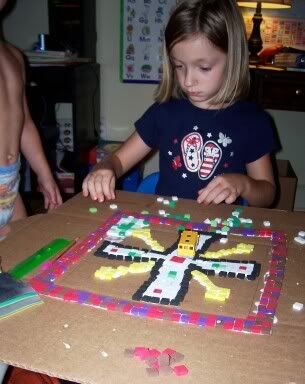
Camille decided to replicate mosaic work from the Hagia Sophia as her art project that week. We both worked on this because 20 minutes into the 2 hour project Camille tired of it and left me with many little mosaic squares to put together. I probably should have had her continue her work but Danny worked against us, he wanted to play with Camille and I just let it go, knowing that we accomplished one key thing- the planning of an art project. We picked out the colors and aligned the squares of the cross as much like the mosaic we were trying to duplicate as possible. Here's the finished product...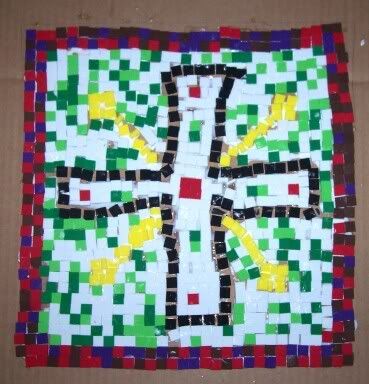
I did all those white and green squares outside of the cross. This art project stayed prominently displayed in her room until we moved and decided to purge it. She would show everyone who visited her project. This year we've been drawing more as we have been sketching in our nature journals.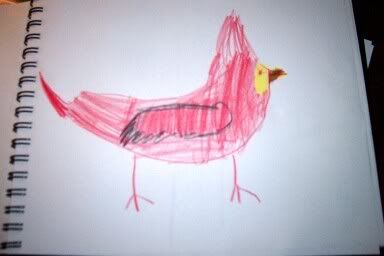
As I've seen her grow in patience, willingness to listen, and in natural artistic ability- I feel we're ready to start Drawing with Children. I'm excited because I've never been formally taught to draw and I find drawing very relaxing. Instead of looking at our art lessons as something to check off our list, √ Art lessons, I want to spend this time with my children and enjoy it. Savoring the time with them doing activities like art lessons, crafts and music appreciation is not only beneficial to their academic lives, but a way to commune with them in an ageless way. One of my hopes for this year is that the kids and I can learn to enjoy and treasure our time together in a productive way, hopefully creating new hobbies for Camille and myself in the process.
From the veterans I've met and other homeschoolers far wiser than I am at this stage, I've heard that their children didn't thank them for teaching history in a certain way, or for being diligent in math, their adult children thank them for the character building and the time their parents spent with them. I don't want to check art or music off my list, I want to enjoy the subjects with my children and create memories.
Here are some helps for Drawing with Children:
Barb of Harmony Fine Arts has created Drawing with Children via Nature Study lessons
she also created a lens page, http://www.squidoo.com/drawingwithchildrennature
Information about Drawing with Children at PaulasArchives.com and other drawing curricula.
Lesson plans one mom wrote for Drawing with Children
Extra practice sheets http://www.donnayoung.org/art/draw1.htm
If you know of any others, please leave links in the comments and I'll put them in the post.
again from my notes...
The year will be split up into 4 quarters, as there are 4 units in each year of TOG. Each quarter will be about 9 weeks with 1 week off. A proposed schedule
Sept 15th - Nov 10th = First Quarter
.............Nov 17-28th off, two weeks
Dec 1-19th, Second Quarter continues..
.............Dec 22-26th off
Dec 29- Feb 6th = Second Quarter
.............Feb 9-13 off
Feb 16- April 17th = Third Quarter
.............April 20-24 off
April 27-June 26 = Fourth Quarter
This will allow us to start AFTER the projected release dates of TOG Redesign Year 3 and Year 4 for 4th grade.
Each Quarter:
Read about and listen to- one composer in the Baroque Period 1600-1750.
1st- Antonio Vivaldi
2nd- Johann Sebastian Bach
3rd- George Frideric Handel
4th - Franz Joseph Haydn (Classical Period 1750-1820)
Focusing on one composer at a time will allow us to rent DVDs, get familiar with their pieces and learn more deeply about each composer. We will read biographies by Opal Wheeler and Madeleine Goss as well as any picture books the library can provide. We will also learn the themes from Themes to Remember 1 by Classical Magic. Camille will work on creating a presentation on each composer.
Scientist Biographies - at least two each quarter
These will be in the framework of our history studies. I have not seen the book list for TOG Year 3 so this will be decided upon later. There will be an extension project, for at least one scientist, utilizing art and writing if not experiments. I think 1 per 3 weeks is more than enough to read and accomplish a project. *I may simplify this to just reading aloud and narrating if it is too much. This will be a Masterly Inactivity exercise.
Art will be through projects and formally using Drawing With Children by Mona Brooks.
She wants art, she'll have art- coming out of her ears! Lol. Nature Journal, Art Lessons, History and Science projects.
I may add more to this later
This year we've incorporated art with history and I couldn't be happier. It is really bringing our studies alive! This week we'll be learning about the early Medieval Indian period in The Story of the World Volume 2 and in the second section of the chapter is about "Monks in Caves".

Today we read about the Hagia Sophia and looked at pictures online. Camille has chosen to attempt to duplicate this mosaic. The circle with the cross. Although I think it's wonderful that she wants to replicate something from the Hagia Sophia, why couldn't she choose a fish? This will be interesting and I hope fun.
Danny woke up from his nap and thought Camille was building him a road! She told him, "No, don't drive your bus all over the cross, Christ died on that cross for our sins and so we can live forever with Him in heaven!!!!" I think she's listening in our Bible lessons! Lol. Wow.The final product. No, I'm not telling you that I was left to finish it about 20 minutes from the time the first picture was taken, or how many vehicles of Danny's has glue on their wheels. Did our lessons go as scheduled? No, and who really cares? This was a lot of fun.In my search to find an art curriculum for my daughter (first grade) that would teach her: how to look at art, how to understand art and learn a little art history and maybe a little artist biography; I have found (rather classykymomma suggested) Artistic Pursuits. I thought my "wants" for an art curriculum were too much but AP is right on track for what I wanted and maybe what you want too...
From Artistic Pursuits' website:
Written for homeschool or independent study, these books are so student friendly that anyone, experienced or novice, will feel comfortable producing original and expressive works of art. Teachers easily adapt the books to the classroom. Using Artistic Pursuits, teachers know that students get a complete overview of the subject of art, written with order and clarity. Artistic Pursuits reaches out to all children and young adults who want to learn, capturing their interests as they work from direct observation and personal preferences. Parents, teachers and students agree that this is the art curriculum they've been looking for!
Units capture students interests and imaginations
while introducing fundamental principles of art.
Units are divided into three sections as follows:
 | What Artists Do: Seven units cover activities artists engage in when making art such as imagining and observing. Students explore both drawing and painting techniques gaining experience in handling a brush. | ||||
| What Artists See: Six units cover the elements that artists use in 2 and 3 dimensional works such as shape, form, and color. Students explore collage, paper works, and color mixing. Students gain experience in handling scissors, glue and paper forms.Exploring Ancient Art: Eleven units cover ancient art from the cave paintings of France to Gothic glass windows. Students see that art is more than just a painting on a wall. Cultures used it in different ways and for different purposes. We expand students ideas of what art is and where it is seen. Students explore mural, pottery, paper art, bookbinding, mosaic techniques and more.
Yes. The unit pages are filled with information and students work on their own paper to create their artwork. You can pass this one down!
K-3 books are designed to be used once per week. Each book lasts approximately a year. Each lesson is about 10 minutes long and then you set them free to make their own art. Students usually work from 30 minutes to an hour depending on age and personality. Grades 4-12 books are designed so that each book has 16 units and four assignments within each unit for a total of 64 projects. Plan two art sessions per week for a year of study/ one lesson per week for 2 years of study. Highschoolers wishing to go through the entire program in one year can schedule 4 sessions per week. We do not suggest this rushed pace for younger students. The projects within the books are not simple half-hour sessions where students copy from the book. Older students will be asked to explore something, observe, or set up their own still life, and then to draw from that. Younger students usually take 45 minutes to an hour to complete an assignment. High School students may take longer. Remember that students are working independently and this reflects student time, not parent time! |
You've got to check out the Book Two and Book Three for K-3 as well. Can I say that I love this? Now if your child(ren) are older they have other grade levels. The price is great too! For one book (The K-3 Book One) is Price: $39.95/print packet included (set of 24 fine art prints) Hello! Print packet included!
I'm just sharing what I've seen in case you've been looking for something like this too. Now, we are really focusing on art this year. We're using Drawing with Children for our art lessons and Artistic Pursuits will be our art appreciation/history lessons. You may not want to do both or as much art. I want as many hands-on lessons our first year as possible to get my dd excited about homeschooling. She already is, but mainly because I tell her of all the neat stuff we'll be able to do together.


 Posts
All Comments
Posts
All Comments