Photobucket Photobucket Photobucket Photobucket Photobucket Photobucket


Showing posts with label language arts. Show all posts

Friday, September 12, 2008

Lessons from Fairy Tales

I received this in Circe's e-newsletter, which can be subscribed to at http://www.circeinstitute.org/

Lessons from a Fairy Tale
by Erin Linton (Guest Writer)

Fairy tales are an invaluable resource for our children - even beyond the enjoyment, heritage, cultural literacy and examples of superb writing and story telling they provide. Without posing the difficulties of analyzing Tolstoy or Augustine, fairy tales like those written by the Brothers Grimm, Hans Christian Anderson and Margery Williams deal with literary technique and questions of life in a simple and instructive way. Margery Williams’ The Velveteen Rabbit is such a fairy tale.

Fairy tales are able to create categories that enable children to make moral judgments about people and situations, and then to assess where they themselves fit into the story. Margery Williams divides those who can become real and those who cannot. The arrogant, modern, plastic toys in The Velveteen Rabbit cannot become real even though they try their hardest to imitate reality with their gears, cranks, and beeps. The soft, forgiving toys, however, such as the rabbit and the Skin horse, can become real. The child is presented with the question, “Who are you more like?”

These fairy stories also raise and answer some of our deepest existential and theological questions. What does it mean to be real? The velveteen rabbit desperately wants to be real, but he does not know exactly what "real" is or how to “become real.” Williams resolves this by saying that it is a long and physically wearing process through the continuing love of and service to the master. The rabbit is loved by the little boy and is eventually called “real” after playing in the garden. He then later serves the boy amidst scarlet fever, bringing about a second “reality.” All of a sudden, the doctrines of justification and sanctification are not so difficult for a ten year old to understand.

While learning to judge the world around them, children also learn how to correctly judge and understand good literature by reading fairy tales. Literary techniques like symbolism, metaphor, allusion, the pathetic fallacy, etc., are vital to fairy tales. A reader of fairy tales must broaden his mind beyond the merely literal to grasp the depths of these stories, which prepares him to read every type of literature. The symbolism of names, for example, is evident in The Velveteen Rabbit; the only two creatures who understand reality are the rabbit, filled with “dust,” and the “Skin” horse, symbolizing that it is mankind who is meant to be real. There is also important symbolism wrapped in times and seasons. In this story, new life comes at Christmas, in the Spring, or in the morning; sickness and death come in autumn or at night.

Even more striking are the literary symbols of water, garden, and darkness. Water is almost always a literary metaphor for cleansing or baptism. It is no surprise then that the velveteen rabbit is left outside to be drenched with dew right before he is “christened” by the boy with the name “real.” It is also fitting that this baptism scene takes place in the garden, a common picture of the church, the new Eden . After the rabbit has received this first reality in his baptism, he lives by faith that he is real, but knows that he is not complete. There are bunnies still more real than he is. After faithfully serving his master, the rabbit symbolically dies. On an autumn night, the unclean rabbit is placed outside the camp/house among the rubbish. There the rabbit dies and is eventually raised and given his second reality by the magic of the nursery fairy. An understanding of these symbols is vital to the understanding of the deeper meaning in Margery Williams’ story, just as it is in all literature.

A last noted benefit of fairy tales is that, unlike “realistic” stories that strip all unnecessary fantasy from the mundane aspects of life, fairy tales strip away the mundane to show us the fantastical, which is usually the most simple and realistic view of the world. From man’s perspective, what else is history but the fantastical transformation of the harlot of Israel into a virgin church bride? What, other than magic, could raise the dead? It’s the same sort of magic that turns a puppet into a real boy, and turns a stuffed bunny with no hind legs into a real bunny that can jump with joy. Our children need to know this magic, need to look for it and realize that this life is not as mundane as the culture would have them believe. This world was created gloriously by the Master and it makes a good deal more sense when viewed through the lenses of fairy tales.

Erin Linton is a graduate of New St. Andrews College and teaches at New Covenant Schools in Lynchburg, VA.

 

Tuesday, August 12, 2008

I didn't realize she loved PLL that much!

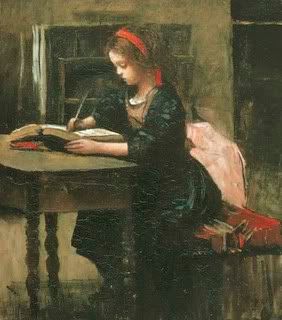
This morning Camille and I did her Primary Language Lessons work, 2-3 lessons worth because she asked to! It wasn't too long because one was an Observation Lesson (questions about everyday things that she answers verbally in complete sentences), a picture study with questions following (we skipped the story writing portion) and she did a written exercise on commas.

I explained to her that in 3rd grade (starts September 15th) we'd only have PLL two times a week, that it would be alternated with her Explode the Code work, which would also be twice a week. PLL on Monday and Tuesday, ETC on Wednesday and Thursday. She didn't like the sound of that.

"Mom, I love my English lessons, can we do them everyday?"
What?!?
I told her we'd see how our days go because we'll have a busier day and she might appreciate only having them twice a week instead of everyday.

I didn't realize she loved Primary Language Lessons that much, I'm glad I went ahead and got the next level for 4th-6th, Intermediate Language Lessons.


Tuesday, February 5, 2008

Making the Change: Spelling

Spelling is the first subject up for review regarding how, when and why. We're in the middle of making a transition to a more natural learning environment instead of forced academics, my main objective is to combine teaching and reaching a child.

In The Well-Trained Mind it is suggested to start Spelling Workout A soon after phonics instruction is done. I've never questioned this, I just did what WTM says thinking that was what was best. Wrong. It's not best, a child needs time to focus on reading skills and even more time to reinforce phonics before diving into another skill to master such as spelling. I thought using Spelling Workout would solidify phonics because it is a phonetic based spelling program.

Camille is not behind at all, she's reading on a 3rd to 4th grade level right now and her fluency is building each day. To be frank, I do not know if Explode the Code is helping or if it has just been time and practice. I suspect it is a bit of both. We've also dropped spelling since we started using Explode the Code and believe it or not, I started worrying about if she'd be able to finish SWO C before 3rd grade. Want to enter my head for a moment here? "If she doesn't finish SWO C in 2nd, then SWO D in 3rd, SWO E in 4th, SWO F in 5th, SWO G in 6th...like WTM says then she'll be behind when..."

Yeah.

Guess what? No more. I have read about how to use dictation to teach spelling which is how Charlotte Mason suggested. I have looked at numerous Charlotte Mason friendly spelling programs. I have read Ruth Beechick and a few other homeschooling books I have here at home and my instinct was right.

You do not need spelling instruction until your child starts composition and certainly not in the formative years of reading. What type of spelling program works best? From my research, spelling that is integrated in with writing works best, the least effective is teaching from spelling lists. If you do teach from spelling lists, it's best to have your child write sentences with the words and then spelling becomes a chore to the child.

Okay, now what? I decided that I didn't want to sacrifice academics by finding a more natural way to learn spelling. So I started looking for something that had the elements of Spelling Workout but was in a different format.

I want something to teach the spelling rules, including suffixes and prefixes as well as root words but in a format that Charlotte Mason would be proud of and I would be excited to use. I looked at a number of programs and finally picked Simply Spelling by Laurie Hicks of Shoelace Books. I was very reserved about using and purchasing an academic item from somewhere I haven't heard of. But it seems a few other homeschoolers I know use and love Simply Spelling as well. That is all the endorsement I need.

We have dropped Spelling Workout completely, Danny will not see a Spelling Workout book unless that format is the best that serves him, although I have a good feeling that won't be the case.

Simply Spelling is a 3rd grade -12th grade product although you can purchase the 3rd and 4th book independently in case you want to "try" it out. It truly is a program that will take minutes a day instead of the 30 minutes for Spelling Workout.

I have read why it is beneficial for children to learn spelling, how it is best taught and when it is best to start teaching. From there I have prayed, thought and sought counsel with other more experienced homeschoolers and decided to find something that would fit both of my objectives, to teach and reach my children. Simply Spelling is our choice.


Sunday, September 30, 2007

Writing Woes: Where's the Path?

I want my children to study the progymnasmata and later rhetoric, the path is not clear as to what to effectively use and when. Here's the list of the programs I'm contemplating and what the problem is:

Writing Tales: If we were to start in 3rd grade, I feel this would best fit my child and create an easy transition into writing without bumping into too many misunderstandings due to terms and the way the program is structured. My only concern is how much of the progymnasmata is covered and whether it would be easy to transition to another program like Classical Composition or Classical Writing if we needed to.

Classical Writing: If this were finished I would feel more comfortable using it, I'm concerned with the timetable of this program, at their website they have

3-4th grade Aesop (Fable)
5-6th grade Homer (Narrative)
7-8th grade Diogenes: Maxim
8-9th grade Diogenes: Chreia

But what about the Refutation, Confirmation, Commonplace, Encomium (praise and blame), Comparison, Speech-in-character, Description, Thesis and Proposal of a Law stages of the progymnasmata?

Their website does have these levels (to come)
Level 4: Classical Writing - Herodotus which is basic argumentation for or against an issue (10th grade?)
Level 5: Classical Writing - Plutarch Description, praise, blame, and commonplace (11th grade?)
Level 6: Classical Writing - Demosthenes, thesis, research, and law. (12th grade?)

Classical Composition
- Jim Selby is a teacher at Whitefield Academy who has devised a progymnasmata curriculum that he has used with his students. I feel the most comfortable using this but I feel the format of the lessons will be a learning curve for me.

4th grade- Fable
5th grade- Narrative
6th grade- Chreia/Maxim, may begin Refutation/Confirmation
7th grade- Refutation/Confirmation, Common Topic, may begin Encomium/Invective/Comparison
8th grade- Encomium/Invective/Comparison, may begin Characterization and Description
9th grade- Characterization and Description, Thesis/Law

Honestly I like this timetable better, I would love to focus 10-12 grades on practical use of what has been learned. Whether or not my children will be able to follow the timetable is a different matter altogether. I have Frank D'Angelo's Composition in the Classical Tradition so I have a reference to use at any time outside of a curriculum, as well as websites. This timetable also allows us to start rhetoric without attempting to do a writing program.

Rhetoric & Logic- the general thoughts: I don't know how timely this path will be until we get closer.
3rd-5th - (Dandy Lion) Puzzles and workbooks
6th- Informal logic possibly with Critical Thinking Books 1 & 2
7th grade- The Art of Argument (Classical Academic Press)
8th grade- Traditional Logic I & II
9th grade- Traditional Logic II or Material Logic I
10th - Classical Rhetoric with Aristotle
11th & 12- Classical Rhetoric with the Modern Student, The Rules of Argument?

I do feel writing, logic and rhetoric blend in certain ways- think, speak, write. I want the materials to mesh well with each other.

I don't feel comfortable making a decision about 3rd grade writing until I feel comfortable about where we'll go after 3rd grade. With Classical Writing, we would not cover the progymnasmata in its entirety, with Classical Composition, I can see that happening. I'm not sure what the best course of action is which make this decision difficult. This is where I find homeschooling difficult, trying to make decisions based on others' opinions and from an uneducated point of view but still do the best for your child without allowing your short-comings to get in the way.

AFTERTHOUGHTS
3rd grade: Writing Tales 1, while going through Classical Composition's Fable myself. Writing Tales has grammar in the program so I can skip a grammar program next year. I think Writing Tales will be a wonderful transition for us into a writing program. In 4th grade, we'll start Junior Analytical Grammar alongside Classical Composition (if that works out for me the way I think it will.) Subject to change, of course.


Saturday, July 21, 2007

Handwriting & Copywork


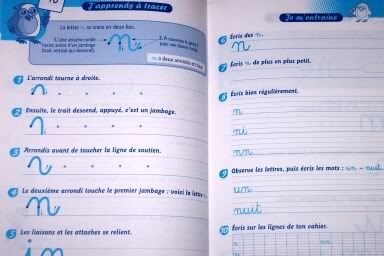
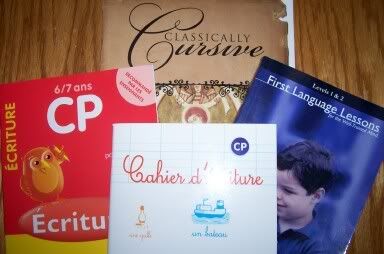
The subject of handwriting is a little tricky for us, because we are studying french. We have been using Classically Cursive from Veritas Press but french script is found in french children's books frequently. In fact we have a few books that are like this. French script has a little more curve than D'Nealian Script (aka Modern Cursive). Camille has been doing well with Classically Cursive and just needs more practice to move away from using a cursive practice book and just writing cursive within her copywork (which First Language Lessons contains), which is the goal for her cursive handwriting.

Spelling Workout C has cursive and print until lesson 19 where it becomes completely cursive. My goal is to help her become cursively fluent by lesson 19. Three goals for handwriting: be able to read french script, become cursively fluent, and move cursive writing into our copywork without the need of a separate handwriting book. (whew!)

I just cannot decide if we should wait on the french script until she does well with the D'Nealian script or do them simultaneously. I guess we'll try it together at first and separate them if there is a problem. I like the french instruction books better anyways! I think the grid (in the other book, inside pages not pictured) and the step by step instruction will definitely help! UPDATE: I'm saving the French script books for when she wants to experiment later on her own with her handwriting.

Copywork.
We will have copywork 3x a week: in grammar with First Language Lessons or from our independent reading, in our history studies and in our science studies. Handwriting and copywork will be done until cursive handwriting can be done in our copywork, and will serve as a motivation to do well in handwriting in order to lighten the load. UPDATE: In our 6th week of 2nd grade, Camille transitioned to doing cursive copywork which has eliminated the need for handwriting being separate. It is going well.

Yes, I am a mean mommy at times.


Friday, July 20, 2007

What is Copywork?


Links and Resources for Copywork

What Is Copywork?
Copywork Products
Free Copywork Resources
Of course, I have copywork linked on the righthand column for SOTW 2 and Earth/Space science. You can also click the "copywork" label and see more posts about copywork.


Friday, June 29, 2007

Creating Copywork Sheets


Super simple, instead of typing out the handwriting lines, just use handwriting paper. Simplicity can be a good friend.


Tuesday, June 26, 2007

Earth Science/Astronomy Copywork

This copywork is intended to go with the Earth Science/Space lessons that I created, however use them how you would like. I'm putting the lesson # and subject so that anyone can use them. We do science copywork once a week. The Earth Science lessons are free to download on the right under Lesson Plans.

Earth Science

Lesson 1: Geology
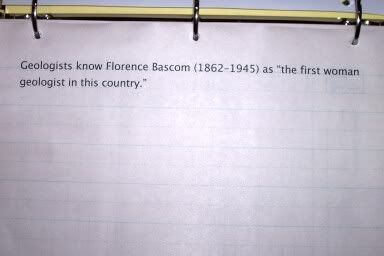
Geologists know Florence Bascom (1862–1945) as “the first woman geologist in this country.”

Lesson 2: Eclipse
Lunar eclipses can only occur during a full moon. Solar eclipses can only occur during a new moon.

Lesson 3: Hemispheres
The word hemisphere means half (hemi) of a sphere.

Lesson 4: Continental drift
The first detailed theory of continental drift was put forth by German meteorologist and geophysicist Alfred Wegener in 1912.

Lesson 5: Lightning
Lightning is a giant discharge of electricity accompanied by a brilliant flash of light and a loud crack of thunder.

Lesson 6: Minerals
A telephone contains over 40 different mineral materials, a television set has about 35, and an automobile about 15.

Lesson 7: Volcanoes
Volcanoes are like giant safety valves that release the pressure that builds up inside the Earth.

Lesson 8: Monsoon
The word monsoon comes from the Arabic word mausin, meaning season, because the storms return year after year at the same season of the year and are essential for crops.

Lesson 9: Avalanche
About 250,000 avalanches occur each year in the Alps, a mountain chain in Europe.

Lesson 10: Tides
Competition between the Sun and the Moon is what causes tides, the rise and fall of the ocean and other large bodies of water.

Lesson 11: Deep Sea
The deep sea is the largest habitat on earth and is largely unexplored.

Lesson 12: Caves
Caves harbor rare animal life, fragile mineral formations and irreplaceable archaeological objects.

Lesson 13: Deserts
Most deserts lie along the Tropic of Cancer and Tropic of Capricorn, imaginary lines that lie north and south of the equator.

Lesson 14: Grasslands
Grasslands would become a forest they received more rain. If grasslands received less rain, they would become a desert.

Lesson 15: Rainforest
A single rainforest reserve in Peru is home to more species of birds than are found in the entire United States.

Lesson 16: Arctic
In 2001, explorers Ann Bancroft and Liv Arnesen made history when they became the first women to cross Antarctica.

Lesson 17: Recycling
Recycling an aluminum can saves enough energy to run a television set for three hours or light a 100 watt bulb for an entire day.

Lesson 18: none


Astronomy

If you’re using the book Spinning Worlds from the lessons I created, you can use the quotes in it for copywork instead of these.

Lesson 1 : Moon
The key to a blue moon is having in the air lots of particles slightly wider than the wavelength of red light (0.7 micron), and no other sizes present.

Lesson 2: Sun
The Sun's temperature is 10,000 degrees Fahrenheit at the surface and 27,000,000 degrees Fahrenheit at the center.

Lesson 3: Mercury
Mercury can only be seen just after the Sun has risen and just before the sun sets.

Lesson 4: Venus
Venus is the only planet in the Solar System to turn clockwise.

Lesson 5: Earth
Earth has more exposed water than land. Three quarters of the Earth is covered by water!

Lesson 6: Mars
Mars has seasons like Earth. This is caused by the tilt of the planet's axis, at a similar angle to the tilt of Earth's axis.

Lesson 7: Jupiter
Jupiter's famous Red Spot is in fact a great storm that has raged for at least four hundred years.

Lesson 8: Saturn
A year on Saturn would take almost thirty Earth years.

Lesson 9: Uranus
Uranus' pale blue colour is caused by the methane in its atmosphere which filters out red light.

Lesson 10: Neptune
Triton orbits Neptune in the opposite direction to the planet's rotation. It is the only large moon in the Solar System to do this.

Lesson 11: Pluto
Pluto was found in 1930 by Clyde Tombaugh, an astronomer looking for "Planet X"

Lesson 12: Comets*
The famous Bayeux Tapestry, which commemorates the Norman Conquest of England in 1066, depicts an apparition of Comet Halley.

Lesson 13: Asteroids*
There are more then 100,000 asteroids in the belt between Mars and Jupiter.

Lesson 14: Space Exploration*
The history of space exploration started with the invention of gunpowder over 10 centuries ago by Chinese inventors.

*These lessons are not planned out in the lessons that I shared which are on the right under Lesson Plans.

If you're curious to how I'm using these, I'm printing them directly onto handwriting paper and place them in our science notebook.


Wednesday, May 2, 2007

Copywork for 400 AD-1600 AD

Also known as the Middle Ages, Reformation and Renaissance Period.

“He succeeded in founding his city, and installing the gods of his race in the Latin land...that was the origin of the Latin nation and the proud battlements of Rome.” The Aeneid, Virgil

“Tempest on the plain of Lir
Bursts its barriers far and near
And upon the rising tide
Wind and noisy winter ride -
Winter throws a shining spear.”
Storm at Sea, Celtic poem

“There is no salvation outside the Church. Love the sinner but hate the sin. Love and do what you will.” St. Augustine of Hippo

“Justice is the constant and perpetual wish to render to everyone his due.” Emperor Justinian

“The world is like a burning house. People are trapped inside, unaware of the flames of petty, worldly desires that threaten to destroy them.” Buddha

“In the name of Allah. The Beneficent, the Merciful.”
Koran, first verse.

“Nothing ventured, nothing gained.”
The Seven Voyages of Sinbad the Sailor.

The Tang dynasty is known as the ‘Golden Age’ of China because it was rich and peaceful.

Japan is called “The Land of the Rising Sun” and China is called “The Land of the Setting Sun.”

The traditional life of the Aborigine is lived close to nature and they are taught, according to the Laws of the Dreamtime, to treat it with great respect.

“Roland has set the horn to his mouth, he grasps it well and with great virtue sounds.” The Song of Roland.

“Be steadfast in prayer. Practice regular charity and bow down your heads with those who bow down in worship.” Koran 2:43

Charlemagne was known as the “Emperor of the Romans” because his empire grew from his valiant efforts. He started schools, built new roads and bridges, and fought wars to build his empire. Charlemagne also desired everyone to become a Christian.

“Since tonight the wind is high
The sea’s white mane a fury
I need not fear the hordes of Hell
Coursing the Irish Channel.”
On the Viking Raids, Anonymous

“Then began I...to turn into English the book that is named in Latin Pastoralis...one-while word for word, another-while meaning for meaning.” Alfred the Great

“A good man was ther of religioun,
And was a poore Person of a town,
But riche he was of holy thought and werk.”
The Canterbury Tales, Geoffrey Chaucer

Samurai are elite Japanese warriors- self-disciplined, honorable, and brave.

“No free man shall be taken or imprisioned or dispossessed, or outlawed or exiled...except by the lawful judgement of his peers or by the law of the land.”
Magna Carta

“The life of a moment, and the life of a thousand years: your life and the life of all the visible and invisible beings in the world, are equal.”
Esarhaddon, King of Assyria by Leo Tolstoy

In Xanadu did Kubla Khan
A stately pleasure-dome decree:
Where Alph, the sacred river, ran
Through caverns measureless to man
Down to a sunless sea.
“A Vision in a Dream” by Samuel Taylor Coleridge

“If you put together all the Christians in the world, with their Emperors and their Kings, the whole of these Christians, - aye, and throw in the Saracens to boot, - would not have such power, or be able to do so much as this Kublai, who is Lord of all the Tartars in the world.”
Marco Polo

1. Ivan the Great united many of the previously autonomous provinces and succeeded in freeing Russia from the Mongols (Tatars).
2. Ivan the Terrible was the first Grand Prince to have himself officially crowned tsar, and treated his people with cruelty.

“I who am Sultan of Sultans, the sovereign of sovereigns,...the shadow of God on earth, the Sultan lord of the White Sea and of the Black Sea...”
Suleiman the Magnificent

“Many died daily or nightly in the public streets: many others died at home.”
Giovanni Boccaccio

“One life is all we have and we live it as we believe in living it. But to sacrifice what you are and to live without belief, that is a fate more terrible than dying.” Joan of Arc

The War of the Roses was fought between two branches of the Plantagenet family, the Houses of Lancaster and York, the wars were named after the emblems of the contending parties: the white rose of York and the red of Lancaster.

Ferdinand II and wife Isabella drove non-Christians from Spain with threats of imprisonment, torture, or death in order to establish Spain as Catholic.

Mansa Musa strengthened Islam and promoted education, trade, and commerce in Mali.

"Nothing happens, but by the will of God." Zahiruddin Muhammad Babur

“I believe that this is a very great continent which until today has been unknown.”
Christoper Columbus

When the Spanish conquerors saw Tenochtitlan they called it "The Venice of the New World".

Cortez seized Montezuma as hostage and forced him to swear allegiance to Charles V, King of Spain.

“All who call on God in true faith, earnestly from the heart, will certainly be heard, and will receive what they have asked and desired.”
Martin Luther

“It is a press, certainly, but a press from which shall flow in inexhaustible streams...Through it, God will spread His Word. A spring of truth shall flow from it: like a new star it shall scatter the darkness of ignorance, and cause a light heretofore unknown to shine amongst men.”
Johann Gutenberg

A peace above all earthly dignities, A still and quiet conscience.
Henry VIII, Shakespeare

Finally we shall place the Sun himself at the center of the Universe.
Nicolas Copernicus

“I know I have the body of a weak and feeble woman, but I have the heart and stomach of a king, and of a king of England too.”
Queen Elizabeth I

“Be great in act, as you have been in thought.”
William Shakespeare

“So the heart be right, it is no matter which way the head lieth.”
Sir Walter Raleigh

“I am inclined to believe that this is the land God gave to Cain.”
Jacques Cartier

Spain was so huge and powerful that it was called “Mistress of the World and Queen of the Ocean.”


Saturday, April 28, 2007

2nd Grade Spelling


We're on Spelling Workout C, after finishing SWO A and B in first grade but instead of doing Spelling multiple days of the week, we'll be doing it once. The words for the week will be introduced on Monday and then on Thursday, Camille will do the exercises in the book.

You can view the inside of Spelling Workout C (or other levels) and the teacher editions at ChristianBook.com
We're only going to do this one level for second grade, it is considered a 3rd grade book.