I hesitate posting about Math on the Level just yet because I have the Starter Set and we haven't used it yet. I went ahead and ordered the rest of the books already though because I am in love.
I have mixed feeling about a few elements so I just share my thoughts, it'll be fun to revisit this post after we've used it for a couple of months. I will not say negative because I don't feel there are true negatives in the program, it really depends on the user, so I'll say concerns instead.
1. There are no grade levels.
Positive: You can move at your child's pace and maturation. You have all you need for K-PreAlgebra (cost-effective) without having to buy anything else unless you choose to for convenience. A concept chart and a suggested teaching sequence are provided, as well as help from other users at the yahoo group.
Concern: There are NO grade levels! Lol. You decide what to teach at what time and you determine what your child is ready for. Of course the suggested teaching sequence is there but if you've used a math curricula- most have the scope & sequence laid out for you. There is no thinking about this on the teacher's part, you just follow the program. This of course is also a positive for the program - you don't have to follow someone else's idea of what is appropriate for your child. If you compare math programs, they are vastly different in scope & sequence - which means it doesn't really matter in the long run.
2. Record keeping
This is really another part of the fact there are no grade levels. There are two things the parent needs to keep track of: the concepts being taught and the 5-a-day reviews. The 5-a-days are 5 math problems that the child solves daily no matter what concept is being taught. The parent provides the problems for the 5-a-days, there are problems provided in the materials. The 5-a-day review has varying levels of frequency: daily, every 2 days, weekly, every 2 weeks, every 3 weeks.
Positive: You can work on what concepts your child needs at their pace. This makes the program spiral and mastery. Concepts are reviewed until a more advanced concept is taught to replace the simpler concept. Instead of using a math program that keeps revisiting the same concepts over and over again each year, the child is mastering the concepts and progressing forward into more advanced concepts as they are ready. The spiral approach is within the 5-a-day review, when the concepts are being reviewed every week then every 2 weeks, finally every 3 weeks. If the child does not do well with the concept then the problematic concept gets taught again and restarted on the review cycle.
Concern: There is a learning curve to figuring out how to use the record keeping yourself, the program provides samples and instructions but how you decide to use it in your own experience, is again...up to you. Another concern I have is the 5-a-days, when I use all of the sample problems, will I be able to make my own? I suspect the answer to this is yes, I will be able to make my own as other users have done or find other resources for problems online or from workbooks. The whole record keeping approach is new to me in math, I'm sure with time it will become second-nature but at first it is very intimidating.
3. Multi-level children can learn together
Children of different ages can be grouped together to cover the same general topic but at varying degrees of the concept. For example:
6 year old is learning how to identify and count money
8 year old is learning how to add or subtract with cent or dollar sign
12 year old is learning how to compute interest or tax
Everyone is learning about money.
Of course since they are different concepts, each child's 5-a-days will be different. One factor that I especially like is that I'm using ONE program for both kids, I can have Camille work on her 5-a-day while I work with Danny on his current concept. While Danny is working on his 5-a-day, I can work with Camille on her concept. Together as a family, we can play games to reinforce the concept.
Positive: Easier on the parent to teach multiple children without juggling multiple programs.
Concern: 5-a-days still need to be tailored to each child.
4. Real life math and teaching moments
Honestly, this was the hook that reeled me in. Real life math, games and utilizing teaching moments in LIFE is what I feel other program lack. Math is a part of life, not just a subject to study from 9:00 am to 9:30am Monday through Friday.
Of course the Concern here is how effective I'll be at taking advantage of real life situations but the positives are apparent. In the Math Adventures book alone:
Cooking: basic cooking activities; metric cooking; nutrition and meal planning/preparation; shopping
Using Money: playing store; games; budgeting and banking; creating a simple business
Travel Time: math games; mental math; math stories; music and memorization; fuel and mileage; maps; charting and graphing
Games: general principals of using games in school; tips for toddlers; purchased games; home-made games; active games
Vocabulary: basic vocabulary words; family vocabulary words; geometry words; geometry words defined
Unit Studies: Unit Studies and Math on the Level
I've already started implementing math in our life- it does take recognizing and optimizing the opportunities though. Yesterday, Danny, Camille and I went to the grocery store to pick up a few items- the kids wanted ice cream. They were both pointing at what type they would like while I was looking at the prices. Pet ice cream half gallon was $2.69 , Camille wanted to get individual pints that were $1.99 each. Instead of saying, "That will cost too much to buy them individually." I let her figure it out.
Camille the pints are $1.99 each so let's round that up to $2.00. How many do you think we'll need? She said, four, one for each of us. I asked her, what is 4 x 2? She said 8. I pointed at the half gallon and said, "how much is this half gallon that we can all share?" She replied, "$2.69." I asked her which one is the better buy? The individual pints that will cost $8 or the half-gallon that will cost $2.69. "Ptch. (I don't know how to translate mouth noises into type) The half-gallon is cheaper! I can't believe they charge so much for the pints!" Camille said.
Okay so in about 5 minutes she multiplied, compared a pint to half gallon and learned to be cost conscious! I'm sure there are other concepts that were touched upon but I'm still learning myself.
I'll figure out the record keeping bit but I'm 98% sure we have a new math program that we're going to LOVE. A few things I didn't touch on- The concepts are parent taught, the books provide all that you'll need including helpful visual aids in color, game suggestions, real life suggestions and different ways to present the concept, sometimes even with different manipulatives. The 5-a-days problems that are provided also have the answers.
Math is not my favorite subject and I consider myself a non-math mom. I don't feel I've touched on every thing about this program, I hope if it sounds interesting that you will read more at the Math on the Level website and join the yahoo group to ask other users.
UPDATE: I've decided to use the Suggested Teaching Sequence and leave the option for rabbit trails open instead of creating a teaching sequence.


Monday, November 17, 2008
First Look at MOTL


Wednesday, November 12, 2008
Monday, November 3, 2008
The Mystery of the Math Switcheroo
Last year when we had trouble in math, it was suggested to make a math lab for Camille- to provide a fun place to do math. We were living in our other house so I was able to do that in a corner. This concept has worked for Camille, she says math is her favorite subject. In our new home, we do not have a math lab.
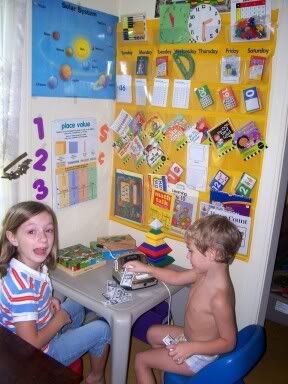
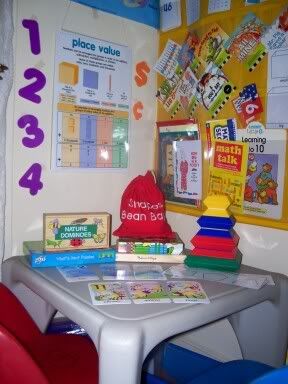
Here's a friend's math lab that inspired me (and many others). We like Horizons Math- I've been saying that for a while and yet what I like about Horizons Math is that it is a colorful workbook curriculum with a teacher's guide. It is not too busy with graphics and it has a spiral approach so Camille keeps reviewing the same concepts over and over again.
I became a little restless last year, hence the math lab, I didn't feel like Horizons was hitting the mark with Camille. Now again, this year I feel the same. The only thing preventing me from switching last year is that I could not find a program that I felt comfortable with, I looked extensively as BJU Math, RightStart, Math U See and other programs that receive very positive reviews. Of course after reading Real Learning by Elizabeth Foss- living math was what I wanted to do but didn't feel the confidence or know-how to accomplish it.
So we stuck with Horizons and I patted myself on the back for staying the course. I think we tried a few different things to help, eventually deciding to cut Camille's work- if she completed the first 1/2 correctly she doesn't have to do the second 1/2. I've used the Teacher's Manual fully, lightly, as a resource and still, I'm not satisfied.
I bought manipulatives, games and then realized we I didn't want to spend so much time on math, the lessons themselves were taking 30 minutes to 1 hour and playing with manipulatives & games just made the time longer. It seems silly not to WANT to take more time for math, something so crucial but I had it ingrained in my head that it shouldn't take 2-3 hours a day, that was an indication of failure.
Now, in 3rd grade- I'm faced with the realization that Camille may not understand much of what I've taught her over the last three years, just enough to accomplish the work but not to apply anywhere else. Yesterday I had her "play" a math game online, easy addition...she scored 25%. What?!? She's in 3rd grade!
She has adapted to Horizons, she does not internalize what she is learning- she just applies her short-term memory to the task in front of her. That is why I've had to reteach the same concepts over and over again. She also is a complete pencil to paper student, unable to do much mental math. I'm unable to teach her how to do mental math because I'm not sure HOW. I've read a few mental math books and I get confused! Lol.
Now for the complete honesty of why I chose Horizons in the first place:
1. It is self-contained, bought in a set complete with teacher's manual.
2. It is cheaper than other programs.
3. It seems rigorous, covering what public school students are covering in the same grade level plus the 1/2 the concepts of the next grade level.
4. Others who use it are homeschoolers I respect and their success (of older students going through the program) was encouraging. Standardized test scores have been wonderful.
Now I realize that:
1. Self-contained is nice but not as important as how the information is presented and learned.
2. Cheaper is nice but not if it is not effective.
3. Rigorous, great but what use is that if your child is not learning the material?
4. Other homeschoolers teach differently, know how to teach math and provide the instruction outside of the teacher's manual. Camille's standardized test scores are not as important to me as what she is learning, anyone can learn to pass the test.
All this and she SAYS math is her favorite subject. Oh boy. Now again, faced with the instinct that she needs something different, I started looking around again- keeping my eyes and ears peeled for reviews of other math programs. In a Charlotte Mason yahoo group I participate in (I mostly read others' messages), the question was posed about living math and Math on the Level was mentioned by its author Carlita.
I think I love it, it is so different from what we're doing now and would provide ME the help I need to understand math in order to teach our children. The pace is determined by the kids, not by a scope and sequence of what a publisher thinks the children should be learning. Math on the Level has resonated with me although I'm still not 100% sure. I've looked at all the other living math curricula that others mention and none of the others make me feel like, "I can do this."
Singapore, Math U See and a few others confuse me, I'll admit. I'm not a math person. I grabbed my copy of 100 Top Picks for Homeschool Curriculum by Cathy Duffy (invaluable book, I've been using it since the beginning and still use it when I have trouble) and I'm also looking into Moving With Math.
We will continue using Horizons until I figure this out. I have many books coming from the library to help me.
1. About Teaching Mathematics a K-8 Resource by Marilyn Burns
2. Teach Your Child Math: Making it Fun for Both of You by Arthur Benjamin
3. Family Math by Jean Kerr Stenmark
and from BookMooch.com (online book trading)
1. Mathematical Reasoning for Elementary Teachers (a textbook on how to teach math)
2. A Collection of Math Lessons from Grades 3-6 by Marilyn Burns
It is my hope with this post to have identified the exact reasons why I'm contemplating a switch in math programs, I am not looking just for the sake of wanting something new. Of course, if I find a different solution, I will post about it but for now- the research continues.
Friday, September 28, 2007
Our Math Lab

Wednesday, September 26, 2007
Quick Thoughts on Elementary Math
Doing the math fact copywork is a major way of relaxing about math facts, it's getting done but it's not a pressure situation. I realized that I need to learn more about teaching math moreso than just blindly following a curriculum. It's not that I don't like or trust Horizons but how can you teach the whys if you don't know them yourself. The answer, "it is just the way I was taught or how I learned" isn't good enough for me.
Second grade isn't that hard to teach, it is the years beyond where my non-math mind will fail. Plus it is always good to have reference resources at hand for any subject you teach, in my opinion. I have oodles of books on foreign language, french, grammar, writing, reading, art and music but math almost has a non-existent presence in our home as far as teaching reference resources.
I'll post more about this as I learn more- about what titles are good resources and about any gems I find. Can I just say upper elementary and middle school math scares the dickens out of me? Lol.
Tuesday, September 25, 2007
Memorizing Math Facts
I don't know which has been the biggest thorn in my side, figuring out narrations or trying to find an effective way to teach Camille her math facts that actually absorbs in. Flashcards haven't been working, worksheets haven't really helped and take forever, games do help but they take a lot of time. I don't want to spend 30 minutes a day doing math facts, nothing kills the enthusiasm faster so only focusing on math facts isn't a solution for us.
Manipulatives slow things down here too and I can't say Camille really gets much from them. We did use popsicle sticks in 1st grade which helped but if I turned my back from her she would organize the sticks by color or make some sort of pattern with the sticks rather than use them for addition and subtraction. Skip counting is better for us now that we're using Intelli-Tunes Skip Counting songs.
We read children's math literature such as Ben Franklin and the Magic Squares, Sea Sums- here's a list of more titles with the concepts they cover. You can also view it as a HTML page here. It is better to download the pdf file and view it that way, I have this chart in my teacher's book. There are many children's math literature lists on the web, I like this one because it is for K-6 and tells me exactly what grade level and concept the book covers so I'm not blindly checking out books.
Math games are very useful for us but it needs to be outside of our lesson time, done informally just for fun. Playing math games with a time limit negates the joy of playing in our house. Camille would play for hours so putting this in the middle of our lessons creates behavior problems, which I'm all for addressing behavior issues but I don't see the need to create any. That said we are having fun playing with the inflatable dice.
Another thing is there are different teaching approaches for math facts (addition).
1+2=3
2+1=3
3-2=1
3-1=2
or memorizing groups of numbers that make the equation
3, 2, 1
2, 2, 4
1, 1, 2
2, 4, 6
memorizing by math familes
1+1
1+2
1+3
1+4
2+1
2+2
2+3
2+4
and there are different approaches for memorizing by math families, see Michele's Math which teaches math families but in a specific order.
Drilling with flashcards or worksheets, playing with games, and real-life math (which we do when we can). All of these ways may work for a child but they don't work for every child. This is where a teacher's frustration comes in. We're going to try math fact copywork since copywork has been successful for us, plus with Camille being a visual learner- writing something down helps cement the ideas in her head. The copywork has the child copy math facts within the math families until they are mastered- how simple is that?
I'll post about how it goes, but I am grateful for such an easy, simple solution right now.
Tuesday, September 18, 2007
Can Learning be FUN?
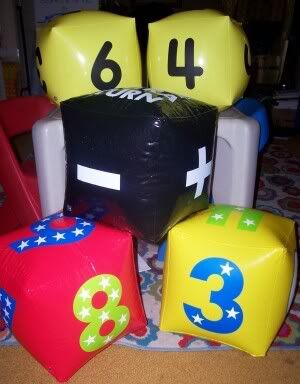

I am so happy with Math for Kicks, we're having a lot of fun! What a lifesaver. We can use it for drill, play it just for fun- which both Danny (3) and Camille (7) are loving.  Safetyville Child's Safety Game - I bought this from D.A.R.E. officers while visiting my parents. We also have the Safe Side DVD on Stranger Safety which has been a HUGE hit at our house. Camille and I played the Safetyville game and it is great, I can also play it with Danny with a preschool focus- added bonus!
There are three sets of questions Beginner (for ages 3-7), Intermediate (7-10) and Advanced (10-13). Preschoolers can also use the game to get familar with key places in their town such as the fire department, police department, etc.
Questions range from stranger safety, keeping secrets, safe practices in the home (chemicals, outdoor dangers, etc.)- it's very wide in it's range.
Sunday, September 9, 2007
Skip Counting Resources
I've been shopping for a skip count cd to help aid our learning in a more fun way. I figured I would share the resources I came across because there is a small selection out there and even I had a hard time deciding! Especially since the samples online at times only give you 40 seconds of the song.
There is a difference in addition, multiplication cds and skip counting. Skip counting is a sequence of numbers: 2, 4, 6, 8, 10, 12, 14, 16, 18, 20...and multiplication songs are usually the facts: 1x1, 1x2, 1x3, etc. There is one exception that I found.
Sara Jordan's Multiplication CD has the multiplication facts and within each number's song, there is a chorus of skip counting for that number. http://www.sara-jordan.com/product-111.shtml
Strictly skip counting cds options:
Intelli-Tunes Skip Counting CD. This is the one we decided to purchase because it wasn't distracting with a bunch of lyrics and got down to the nitty-gritty of the number sequences, much like I've been doing on my own.
http://www.songsforteaching.com/store/Intelli-Tunes-Skip-Counting-CD-p-1182.html
Skip Count Kids has two versions, one that would be considered secular and one that has Bible songs. We own the The Skip Count Kids Bible Heroes and like it but the number sequences only go so far in some of the songs. This has been great for us and I like the Bible Hero lyrics. Camille still sings these songs for fun.
Skip Count Kids at SingnLearn.com, link to Bible Heroes version too.
One Hundred Sheep is another skip count CD available at Singnlearn.com, I was unable to determine how complete the sequences were but the sample sounded good. This has been recommended by other homeschoolers yet without more information I could not commit to purchasing it. One Hundred Sheep at Singnlearn.com
Googol Power Skip Counting Zone CD is a lot of fun with all different types of music. The samples are great, providing a sample for each song, which I was grateful for! Unfortunately, Camille prefers not to have so many lyrics, although this isn't lyric heavy in my opinion. It is definitely a CD that I would consider "fun" listening but I didn't have the need to purchase more than one CD at this time. Googol Powers's Skip Counting Cd link
Musical Mathematics with Skip Counting CD by Liz Robinson is a filled with different types of music and provides the instrumental versions of the songs so that you can see if your child can skip count without the lyrics. There are worksheets and teacher's aids available as well. I thought this was great but we're picky (or Camille is) and didn't prefer the music. Link to Musical Mathematics
Math-U-See Skip Count Songs is for Math-U-See users although some have bought this without using Math-U-See. I didn't explore this further than other homeschooler's reviews of it, it seems that no one has really enjoyed this and tend to look for other options, the sample doesn't help in my opinion either. Link to Math-U-See Skip Count Songs
Skip Counting CD by Little Giant Steps. I couldn't find much information on this other than it says there is no music. I didn't consider this further due to lack of information on the product (hint, hint to the vendors and suppliers!).
Link to Skip Counting by Little Giant Steps
Obie Leff's Skip Counting Fun, this is great for the number sequences but Camille said the music is boring. His songs are available at iTunes Music Store so you can preview each song yourself, CD Baby has the song samples as well. This was a contender until we found Googol Power and Intelli-Tunes. Link to CD Baby's listing of Skip Counting Fun
TouchMath's Skip Counting CD and Poster set. This looks great but I can't afford the $75 for it. I think it's a great idea but a resourceful teacher could easily recreate the posters if he/she wanted to. I couldn't find samples of the songs either. Touch Math link
That concludes our search for skip counting CD's, the search gets a little mucky after these selections- some CDs have skip counting songs on them mixed in with other math related songs. If you know of another that you feel should be added to this resources list, let me know. The comments made above are only Camille's (7yo) and I opinion of what we sampled, one of these resources that we didn't like may be the perfect thing for your family.


 Posts


 |